90s nostalgia fashion: which trends actually work today?
The silhouettes are familiar, but the fabric, proportion, and styling have changed enough to make the difference between a reference and a costume.
That distinction matters. Celebrity style has always used nostalgia as narrative control: a plaid skirt says Clueless, a bias-cut slip says red-carpet minimalism, a flannel says the grunge fashion comeback. But a workable wardrobe needs more than a recognizable cultural citation. It needs range. Can the piece survive daylight? Can it meet a blazer, a practical shoe, an actual calendar? If the answer is no, it may be great archival fashion—but not one of the 90s trends to wear now.
The short version: keep the slip dress, wide-leg denim, upgraded cargos, and restrained grunge. Be much more selective with literal schoolgirl styling, ultra-low rises, and anything whose only job is announcing that you remember 1997.
The best retro 90s outfits do not recreate the decade. They keep its confidence and renegotiate its proportions.
The evolution of the 90s aesthetic: from rebellion to polish
The original 90s fashion story was never one clean look. It held several competing identities at once: minimalism in satin, grunge in flannel, preppy pop in plaid, hip-hop’s oversized denim, and utility dressing in cargo pockets. That is why the decade keeps returning. It offers a usable visual language rather than one uniform.
But the modern relationship with 90s celebrity style is more edited. We no longer need to dress exactly like a paparazzi photo from 1995 to understand its appeal. A slip dress recalls that stripped-back, post-supermodel glamour. A roomy jean carries the ease of off-duty stars leaving LAX before “airport style” became an industry category. A sharply cut cargo can nod to the era’s streetwear without asking anyone to live in an actual parachute pant.
Interest in 80s and 90s fashion rose substantially during 2025, but the 2026 version is not driven by pure replica dressing. The pieces that have lasted are the ones designers can make better now: softer fabrics, more deliberate tailoring, less punishing fit. That is not a betrayal of the decade. It is the point of a revival with self-respect.
There is also an emotional shift. Original 90s style often performed indifference: the oversized sweater, the barely-there makeup, the deliberately worn-in denim. Today’s wearer usually wants the same ease without the implication that effort is somehow embarrassing. The outfit can look relaxed while still showing judgment.
If then: if your 90s reference relies on discomfort, exposure, or a body type as its entry ticket, leave it in the archive. If it relies on proportion, texture, and attitude, it has a future.
Slip dresses versus tailored cargo: two winners with different jobs
The slip dress and cargo pant have both outgrown their original stereotypes. One was once coded as fragile, late-night, and slightly dangerous; the other as utilitarian, masculine, and deliberately unpolished. In 2026, they meet in the middle: both are flexible staples when the cut is intentional.
A modern slip is not necessarily the thin polyester number that catches on every door handle and reveals the outline of a chair after dinner. The best ones use satin, silk, or Tencel with enough weight to skim rather than cling. They are often worn under a structured blazer, with a fine knit, or with a clean leather jacket. That extra structure changes the optics completely. It turns a nostalgia piece into something that can move from a dinner reservation to a daytime event without a full identity change.
Tailored cargo pants have made an equally useful transition. The modern pair is cut in twill, Tencel, or satin, with pockets that sit flat and a leg that has shape. They should not balloon at the thigh and collapse at the ankle unless your goal is explicitly skate-inspired. Most people are better served by a relaxed straight leg or a measured wide leg, then a fitted tank, crisp shirt, or compact blazer above it.
| Parameter | Refined slip dress | Tailored cargo pant |
|---|---|---|
| Best 90s reference | Minimalist red-carpet glamour | Urban utility and late-90s streetwear |
| What makes it current | Weighty satin, silk, or Tencel; layered styling | Flat pockets, elevated fabric, controlled volume |
| Strongest pairing | Structured blazer and sleek flats or boots | Fitted knit, white shirt, or tailored jacket |
| Common failure point | Too sheer, too clingy, too lingerie-coded | Excess fabric, bulky pockets, sloppy hems |
| Wearability verdict | Excellent, especially for evening-to-day dressing | Excellent, particularly for casual workwear |
The slip dress wins for emotional versatility. It can read romantic, cool, formal, or slightly guarded depending on what is layered over it. A leather jacket gives it boundaries; a blazer gives it professional credibility; a fine cardigan softens the whole narrative. It is one of the rare retro pieces that can genuinely accommodate different versions of a person.
Cargo pants are more pragmatic. They offer ease without surrendering polish, especially at a time when athleisure continues to cross into tailored dressing. A performance sneaker with suit pants is now a familiar equation; cargos with a sharp jacket follow the same logic. The key is keeping one half of the outfit disciplined. Loose cargo pants plus an oversized hoodie plus a giant sneaker can work, but it is a specific streetwear mood, not a universally flattering default.
A good cargo pant has utility in its construction, not a desperate need to prove it has pockets.
The new preppy: plaid still works, but the yellow set has retired
There is a reason the Clueless plaid skirt suit remains lodged in the public imagination. It was clean, coordinated, and instantly legible. Cher Horowitz did not just wear yellow plaid; she used it to project authority inside a highly controlled teenage world. The outfit had narrative control before we had the language for it.
That does not mean the exact bright-yellow skirt set needs to return wholesale.
Today’s preppy plaid works best when it is less literal. Forest green, rich brown, deep burgundy, charcoal, and muted navy bring the same visual structure without making the wearer look as though she is headed to a theme party. The scale of the check matters, too. Fine checks and restrained tartans tend to integrate more easily into a contemporary wardrobe than loud, high-contrast patterns.
The 2026 checked-print resurgence is wider than suiting: gingham, flannel, babydoll dresses, and balloon shorts are all part of the conversation. But not every checked item carries equal long-term value. A plaid mini can be charming; a plaid mini with knee socks, a cropped cardigan, platform Mary Janes, and a tiny backpack is a very specific editorial sentence. It may be a fun one. It is not necessarily a life sentence.
For a version with better longevity, try one of these approaches:
1. Treat plaid as tailoring, not costume. A brown or burgundy checked blazer with dark denim has the clean, capable energy of 90s prep without the cartoonish sweetness.
2. Break up the matching set. Wear the skirt with a plain crewneck knit, or wear the blazer over a simple column dress. Separates create breathing room.
3. Choose a grown-up hemline and fabric. A knee-skimming A-line skirt in wool blend will outlast a flimsy micro-mini, both physically and emotionally.
4. Let one detail carry the reference. A plaid hair ribbon or compact shoulder bag can be enough if the rest of the outfit is modern and spare.
5. Skip the full character package. If every element points to a single movie still, the outfit loses its own point of view.
This is where retro dressing often gets tangled. People confuse accuracy with style. But accuracy is for costume departments; style is for people with meetings, moods, and changing weather.
Denim shifts: why anti-fit won the war
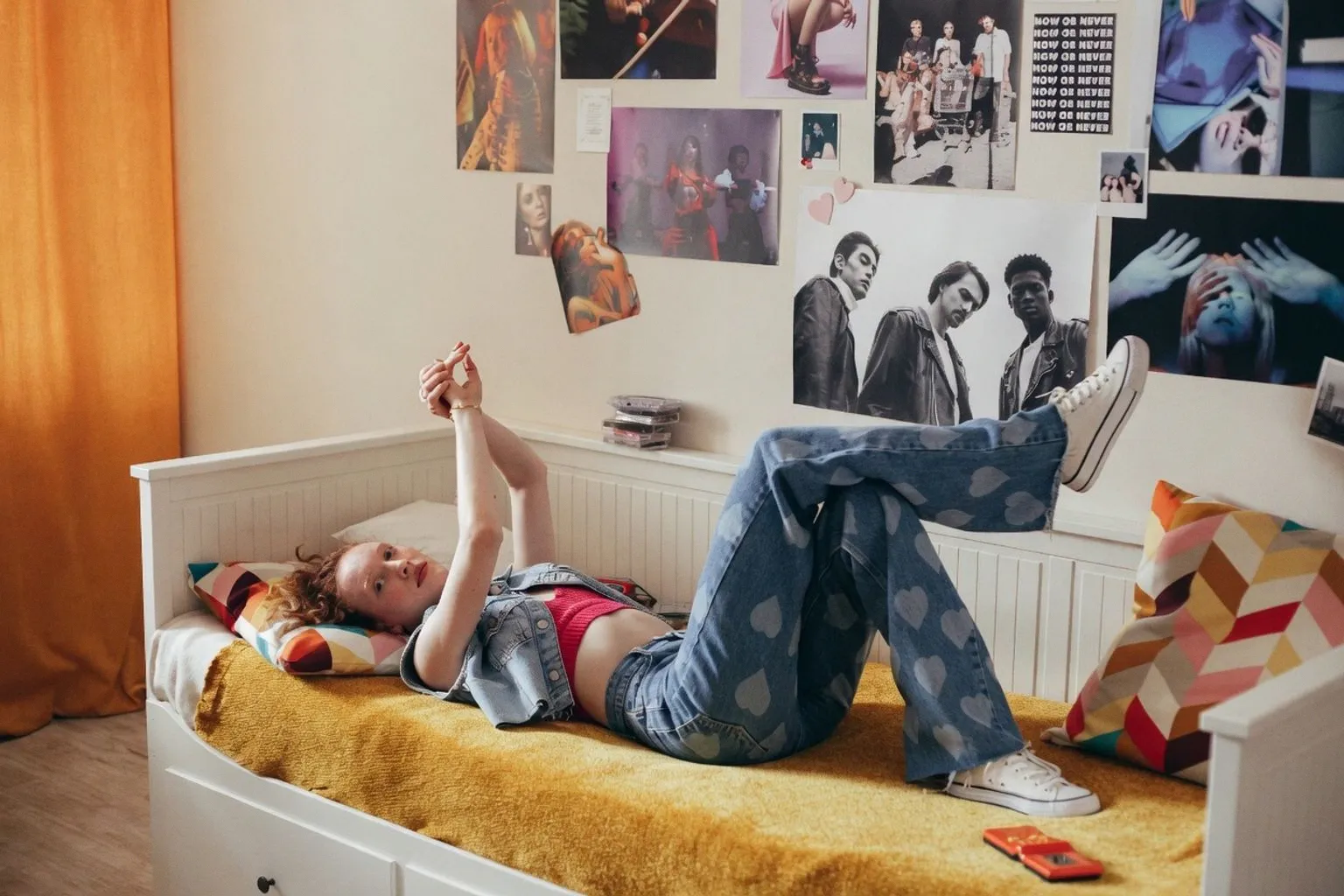
Skinny jeans are not forbidden. They are simply no longer the dominant denim silhouette, and pretending otherwise would be a strange form of fashion denial. Wide-leg, baggy, and relaxed anti-fit jeans have taken over because they offer what many of the best 90s looks offered in the first place: room, movement, and a little distance from the body.
That distance is central to their appeal. The anti-fit silhouette does not require the wearer to negotiate every curve or spend the day adjusting a waistband. It gives an outfit a more relaxed emotional register. A good pair can look grounded with a white T-shirt, intentional with a blazer, or polished with a slim knit and pointed shoe.
The challenge is proportion. “Baggy” is not a free pass for shapelessness. The jean should sit securely at the waist or hip, depending on the rise, and its hem should have a clear relationship with the shoe. A puddle of denim dragging behind a sneaker is not vintage; it is just evidence that the jeans were never altered.
Here is the comparison most wardrobes need:
| Denim choice | What it gives you | What to watch | Verdict for 2026 |
|---|---|---|---|
| Wide-leg jean | Length, balance, easy polish | Too long a hem can overwhelm the look | The strongest all-purpose choice |
| Relaxed straight jean | A subtle 90s nod with low risk | Can look plain if the wash is too flat | Reliable and easy to repeat |
| Baggy anti-fit jean | Genuine streetwear energy and comfort | Needs a defined waist or compact top | Great, but more styling-sensitive |
| Ultra-low-rise jean | A direct pop-culture reference | Limited comfort and difficult proportions | Best treated as occasional, not foundational |
| Spray-on skinny jean | Clean line under tall boots | Can feel dated as a default silhouette | Keep only if it serves a specific outfit |
A medium or darker wash usually makes the transition easier. Heavy whiskering, excessive rips, and low-slung hardware can push the piece toward a period replica. Distressed denim can still work, but its distressing should look intentional, not like it is auditioning for a 1998 music video.
If then: if you want your denim to carry the outfit, choose a wider leg and simplify everything else. If you want the outfit to feel sleek, choose a relaxed straight leg and let the shoe, jacket, or bag do the talking.
Polished grunge: keep the texture, lose the neglect
The grunge fashion comeback is real, but the version that works today is designer-led rather than accidentally disheveled. That is a meaningful difference. Original grunge style drew power from its refusal to look polished. In 2026, the most convincing interpretation uses premium soft-brushed cotton, wool-blend flannel, and tailored distressed denim. It acknowledges that the look is being chosen.
This may sound less romantic than the mythology of the thrift-store flannel, but it is more useful. A substantial checked overshirt can be worn open over a ribbed dress, buttoned with dark trousers, or tucked loosely into wide-leg jeans. A soft wool-blend flannel has texture without looking exhausted. The wearer gets the mood—slightly defiant, not overly precious—without losing the ability to enter a restaurant that uses cloth napkins.
The crucial boundary is between wear and decay. Distressing should be placed: a frayed hem, a faded knee, a softened seam. Random tears across every surface create visual noise and rarely read as personal style. Similarly, combat boots remain a good investment when they are clean enough to look deliberate. The goal is not to look untouched. It is to look like you made a decision.
This is also where celebrity throwbacks can mislead. A candid 90s photo of a star in a giant cardigan, smudged liner, and battered boots may have had the charisma of genuine off-duty life. Recreating it piece by piece can flatten the original magic. The camera captured a person in motion; the copy can become a frozen reference.
A better way to borrow the energy is to use one grunge element against something refined:
- a brushed flannel over a satin slip;
- a faded band tee with tailored trousers;
- distressed wide-leg denim with a sharp black blazer;
- lace-up boots beneath a clean midi skirt;
- a checked shirt with a polished leather bag instead of a chain wallet and five competing accessories.
That tension is the modern upgrade. It keeps the emotional honesty of grunge while recognizing that a complete look needs hierarchy.
What should stay in the 90s, at least most of the time
Not every revival deserves a full reunion special. A few 90s signatures are more memorable than wearable because they rely on extreme proportions or narrow cultural context.
Ultra-low-rise pants can be fun in an editorial setting, but they are not the default solution for most bodies or most days. Tiny tinted sunglasses are a styling accessory, not an eye-care strategy. Head-to-toe logo mania often looks less nostalgic than commercially anxious. And the combination of micro-mini, crop top, platform shoe, visible thong straps, and aggressively tiny bag is best approached with honesty: it is a nightlife costume, even when it is expensive.
None of this is moral judgment. Fashion does not need to be universally practical to have value. The question is whether a trend offers enough flexibility to earn closet space. A piece can be iconic and still not be a wise purchase.
The most successful 90s nostalgia fashion understands that difference. It does not ask you to become a museum exhibit of your favorite celebrity era. It gives you a strong silhouette, a texture with history, and enough room to make the reference your own.
The verdict is refreshingly clear: invest in a weighted slip dress, well-cut cargos, relaxed denim, muted plaid, and one excellent flannel layer. Let current fabrics and tailoring carry the nostalgia. The decade was never really about looking careless. It was about looking like you had your own rules—and knowing which ones were worth keeping.