Compare replica celebrity engagement rings by price
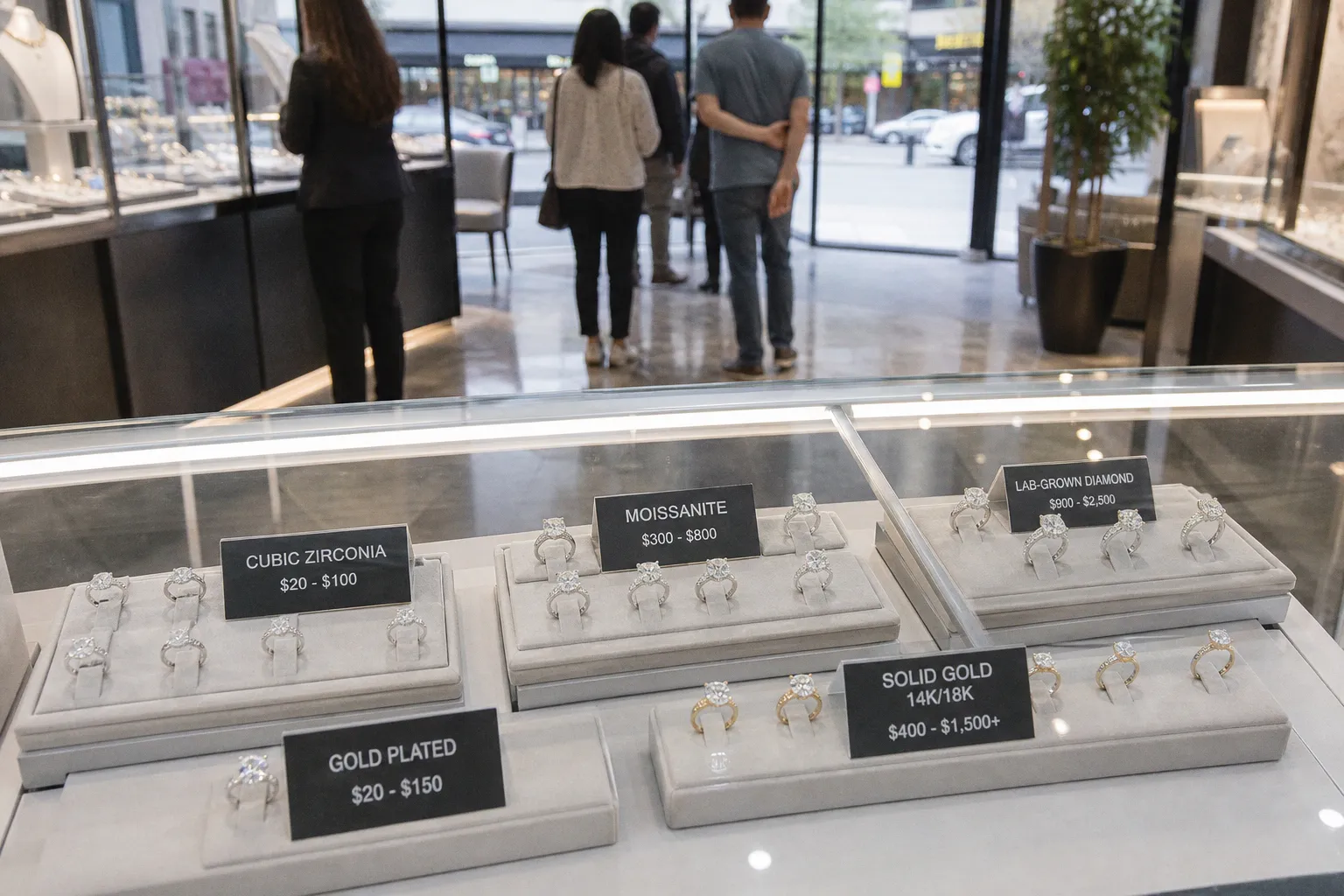
The market for replica celebrity engagement rings now spans a price spectrum so wide that a $30 piece of costume jewelry and a $4,500 lab-grown diamond alternative can both legitimately claim to "recreate" the same piece worn by a Hollywood A-lister on a red carpet within the last three years. The gap between those price points is not a matter of brand markup, boutique overhead, or licensing fees — most replicas are unauthorized third-party interpretations, not licensed merchandise. It reflects three independent variables: center-stone composition, metal alloy, and setting craftsmanship. Buyers who evaluate them as a single bundled product are the audience the replica market depends on.
For readers weighing how to check compare replica celebrity engagement rings by price, the honest answer begins with abandoning the assumption that "replica" describes a single category of object. It describes an output — a ring intended to evoke a specific celebrity original — produced from materials that range from acrylic to chemically identical laboratory diamond. The journey from one end of that range to the other passes through three discrete tiers of stone technology, each with its own optical profile, its own durability curve, and its own price logic.
The Hierarchy of Sparkle: CZ, Moissanite, and Lab-Grown Diamond
Cubic zirconia, moissanite, and lab-grown diamond are not interchangeable synonyms for "fake diamond." They are three distinct materials occupying three different positions on the Mohs hardness scale, with three different refractive indices, and three entirely different relationships to long-term wear. A price comparison that treats them as equivalent will systematically mislead buyers about what they are actually receiving.
| Parameter | Cubic Zirconia (CZ) | Moissanite | Lab-Grown Diamond |
|---|---|---|---|
| Mohs hardness | 8.0–8.5 | 9.25 | 10 |
| Refractive index | 2.15–2.18 | 2.65–2.69 | 2.42 |
| Price range (solitaire, 1ct equivalent) | $20–$150 | $300–$1,500 | $800–$5,000+ |
| Optical character | High brilliance, low fire | Pronounced rainbow fire | Balanced brilliance and fire |
| Long-term behavior | Clouds within 2–4 years of daily wear | Retains clarity indefinitely | Indistinguishable from mined diamond over decades |
| Resale value | None | Minimal | 30–60% of retail for certified stones |
Cubic zirconia is the workhorse of the budget replica tier. Dense, optically convincing at a glance, and inexpensive to manufacture, it dominates listings under $100 — and it explains why the lower half of the market looks so similar in vendor stock photographs. Its weakness is structural rather than visual: at 8 to 8.5 on the Mohs scale, it accumulates micro-abrasions from routine contact with skin, fabric, and household surfaces. Within two to four years of daily wear, the stone takes on a hazy, frosted quality that no cleaning restores. For buyers who treat a replica as a temporary or fashion-tier object, this is acceptable. For buyers who expect the piece to photograph or present like the celebrity original indefinitely, it is a non-starter.
Moissanite occupies a strange and frequently misunderstood middle position. It is harder than CZ and considerably more brilliant, with a refractive index that actually exceeds diamond — which produces more fire, more rainbow dispersion, more visual movement than the natural stone it is imitating. This is its commercial argument and its commercial problem simultaneously. A moissanite center stone often looks more dramatic than the celebrity original, which frequently used a diamond of modest carat weight set in a refined mounting where the stone's restraint was part of the design vocabulary. Buyers seeking verisimilitude should know that moissanite reads as "expensive" but does not always read as "diamond." The double-refraction property — the way light splits into two rays as it passes through the crystal lattice — is detectable under magnification and, in larger stones above two carats, occasionally visible to the naked eye as a faint doubling of facet edges. For most onlookers at conversational distance, this is invisible. For a buyer whose entire purpose is to replicate a specific celebrity photograph taken at close range, it is a detail worth understanding before purchasing.
Lab-grown diamond is the only material in this hierarchy that is, at the molecular level, diamond. The Federal Trade Commission recognized this equivalence formally in its 2018 Jewelry Guides revision, removing the word "natural" from its definition of the stone. The replica market has been slow to adopt lab-grown centers at scale — partly because the price differential against a comparable mined diamond has narrowed, partly because most replica vendors target buyers who want visual impact per dollar rather than gemological authenticity. Where lab-grown stones do appear in replicas, typically in the $800–$5,000 band, they tend to be set in solid 14k or 18k gold rather than plated alloys, which compounds the cost but extends the lifespan of the piece by decades. Lab-grown stones also carry grading reports from the same laboratories — IGI, GCAL — that certify mined diamonds, which means the buyer receives a document describing cut, color, clarity, and carat with the same vocabulary used for stones extracted from the earth. That certification is the single largest differentiator between a lab-grown replica at $2,000 and a moissanite replica at $600: not the visual performance, which is comparably striking, but the paper trail that accompanies the stone.
Metal Matters: Plated Brass Is Not Solid Gold
The center stone absorbs most of a buyer's attention during the comparison process. The metal does most of the actual work of distinguishing a wearable heirloom from a seasonal accessory, and it is the variable where replica vendors are most creative with their language.
"Gold-tone," "gold-colored," "gold-finished," and "gold-plated" are not interchangeable. The first three describe a color finish on a base metal — typically brass, copper, or zinc — applied by physical vapor deposition or electroplating in a layer measured in microns. The thickness of that layer determines how long the finish survives contact with skin, lotion, perfume, and water. A plating thickness below 0.5 microns, common in the under-$100 segment, typically wears through to the base metal within six to twelve months of daily wear, after which the ring develops the dull, brassy patina that marks the costume-jewelry tier unmistakably.
Vermeil — a term with a legal definition in the United States — requires a minimum of 2.5 microns of gold plating over a sterling silver base. It occupies the space between costume and fine jewelry: more durable than thin-plated brass, less expensive than solid gold, and acceptable to buyers who want a precious-metal base without the full weight cost. Several mid-tier replica vendors in the $150–$500 band use vermeil as their premium option, and for a buyer who does not intend daily wear for more than a few years, it is a reasonable compromise.
Solid gold, by contrast, is an alloy throughout. A 14k gold ring contains 58.3% pure gold mixed with copper, silver, and other metals for hardness; an 18k ring contains 75%. Neither will tarnish, neither will expose a base metal beneath a worn finish, and either will survive decades of daily wear with only routine polishing. The price differential between a gold-plated brass replica and a solid 14k gold version of the same design routinely reaches eight to fifteen times — not because the setting is more complex, but because the underlying material is fundamentally different in mass, in longevity, and in scrap value. A 14k gold setting also holds its center stone more securely over time: the prong metal is harder, denser, and less prone to the fatigue fractures that eventually claim plated base-metal settings after repeated flexion.
Sterling silver occupies an intermediate position. It is a precious metal (92.5% silver, 7.5% copper) with genuine longevity, but it tarnishes on contact with sulfur compounds in the air and requires periodic cleaning. In the replica engagement ring market, sterling is most often found as a setting material for moissanite or low-carat CZ stones in the $150–$400 band, where it offers a reasonable compromise between durability and cost for buyers who are not yet ready to commit to a solid-gold mounting. The tarnish issue is cosmetic rather than structural — a silver ring that darkens with wear can be restored to its original luster with a standard polishing cloth in under a minute — but buyers who want a maintenance-free metal should budget for gold from the outset.
A note on skin reactions
One consideration buyers frequently underestimate: prolonged skin contact with low-quality plated base metals — particularly those containing nickel — can produce contact dermatitis in wearers with existing sensitivities. The visible symptoms, including redness, itching, and discoloration of the skin beneath the band, are often misattributed to the stone or the setting style when the actual culprit is the alloy beneath the plating. Nickel sensitivity affects an estimated 10–20% of the population, and the condition does not require direct allergy — repeated exposure can induce the response over time in previously unaffected wearers. If a new ring produces persistent irritation, the most reliable first step is removing the piece for 48 hours and observing whether the skin clears. A pattern of irritation that resolves when the ring is off and returns when it is on almost certainly points to the metal rather than trapped moisture or soap residue, and switching to a nickel-free sterling silver or solid gold setting typically eliminates the problem entirely.
The Price Gap: What You Actually Pay For
A replica engagement ring priced at $45 and a replica priced at $2,400 may carry photographs of the same celebrity original. The difference in price is not arbitrage, and it is not retailer margin. It is allocated across budget categories that scale non-linearly with the final sticker.
In the under-$100 segment, the dominant cost is the setting itself — the metal alloy, the casting, the stone-setting labor — followed by a thin margin for the vendor. The center stone, if CZ, costs the manufacturer a few dollars. There is no certification, no hallmarking, and no warranty beyond the standard return window. Pieces in this range are often manufactured in shared foundries that produce costume jewelry for multiple brands; the "replica" designation is applied at the design and packaging stage, not at the production stage. The resulting rings can be visually convincing in a posed photograph but reveal their nature quickly in person — the weight feels wrong, the prong edges catch on fabric, and the base metal warms to the skin temperature almost instantly in a way that solid precious metals do not.
In the $300–$1,500 segment, the center stone becomes the largest single line item. Moissanite of meaningful carat weight (1ct and above) costs the manufacturer $80–$400 wholesale, and that cost passes to the buyer with markup. The setting is typically sterling silver or low-karat gold. Vendors in this range frequently provide a basic authenticity certificate for the stone and a one-year limited warranty against setting defects — a meaningful upgrade from the costume tier, though still a long way from the standards applied to fine jewelry. The visual jump from a $100 CZ replica to a $500 moissanite replica of the same celebrity design is disproportionately large: the stone looks genuinely different under both direct and ambient light, and the metal weight and finish communicate a category shift that photographs alone cannot convey.
In the $800–$5,000+ segment, the cost structure inverts: the setting becomes the dominant expense, because solid 14k or 18k gold at current spot prices accounts for the majority of the bill. A lab-grown diamond of comparable size costs the vendor less than the gold it sits in. Buyers at this tier are paying primarily for metal mass and certified stone provenance — the two variables that give the piece any meaningful secondary-market value.
The replica market is not priced by how closely the piece resembles the celebrity original. It is priced by how long the piece will continue to resemble anything at all.
Durability Reality Check: Which Stones Endure
A daily-wear engagement ring endures an estimated 1,500 to 2,500 incidental contacts per day — with fabric, with water, with hard surfaces, with other jewelry. Over a decade, that accumulates to between five and nine million micro-impacts. The material that survives that volume of contact without visible degradation narrows the field considerably.
CZ fails first, almost always at the stone. The surface clouding is irreversible; repolishing the stone restores it briefly but accelerates the cycle. A CZ replica worn daily is typically a two-to-five-year object, after which it reads unmistakably as costume. The degradation is gradual enough that the wearer may not notice it day to day — until a side-by-side comparison with a new CZ piece reveals how much brilliance the older stone has surrendered. At that point, the buyer faces a choice between replacing the stone, which costs nearly as much as the original ring in the budget tier, and replacing the entire piece.
Moissanite, at 9.25 on the Mohs scale, is durable enough for a lifetime of daily wear with no optical degradation. Its only vulnerability is the setting: a moissanite stone will outlast a plated-brass mounting by decades, and the buyer who chooses the wrong setting tier will replace the ring long before the stone gives out. This is the most common complaint in mid-tier replica reviews — not that the stone failed, but that the prong metal fatigued, bent, or lost its plating while the center stone remained visually flawless. The lesson is straightforward: in the moissanite tier, the metal choice matters more than the stone choice.
Lab-grown diamond, at 10, is functionally indestructible in any setting. The limiting factor is the metal — even a solid gold mounting will eventually require prong retipping after fifteen to twenty-five years of wear, but the stone itself will outlast every other component of the ring indefinitely. Buyers who invest in this tier are buying a stone that will, barring catastrophic physical impact, look identical in thirty years to the day it was purchased. The metal will need periodic attention; the stone will not.
Most replicas have no resale value. Treating the purchase as disposable from the outset is the only honest pricing framework — unless the stone is certified lab-grown diamond in a solid precious-metal mounting.
Setting Accuracy: Why $50 Cannot Photograph Like the Original
The celebrity engagement rings most frequently replicated — the emerald-cut solitaire that has dominated engagement jewelry coverage since the late 2010s, the elongated cushion halo, the three-stone setting with tapered baguettes — appear deceptively simple in vendor photographs. Their visual impact depends on a handful of precise tolerances: prong height and taper, gallery depth, stone calibration (the alignment of the center stone's table with the setting's geometry), and metal finishing. A $50 cast brass setting produced in high volume cannot hit those tolerances. The prongs will be slightly uneven. The gallery will be slightly shallow. The stone will sit slightly off-center. None of these defects is visible in a vendor's stock photograph, and all of them become visible under direct light, in person, or in a candid photograph rather than a posed one.
The proportions are where budget replicas most consistently fail. A celebrity emerald-cut solitaire photographed on a red carpet and reproduced from that image will be interpreted by the replica manufacturer from a single angle, usually at a magnification that obscures the relationship between the stone's length-to-width ratio and the setting's finger coverage. The result is a ring that looks correct when viewed from above and feels entirely different when it arrives — too narrow, too wide, too tall on the finger, or too bulky for the hand that wears it. These proportion failures are invisible in product photography and immediately apparent in person, which is precisely why the replica market can sustain a hundredfold price range on what appears to be the same design.
Designer provenance matters here in a way that the replica market rarely acknowledges. The houses whose pieces generate the most persistent waves of replicas — Van Cleef & Arpels, Cartier, Tiffany & Co., Harry Winston — engineer each setting around a specific stone. The setting is built around the stone; the stone is cut to fit the setting. A "replica" of such a piece is, at any price, an interpretation of proportions and silhouette, not a reproduction of an engineering relationship. Buyers who value the original's visual logic should understand that even a $4,000 lab-grown diamond interpretation of a Van Cleef mounting is reading the original through a different manufacturing vocabulary.
The demi-fine tradition — a category that includes brands like Kenneth Jay Lane and several contemporary direct-to-consumer labels — has historically occupied the space between costume and fine jewelry by offering settings of credible craftsmanship in plated or vermeil metals. These pieces photograph well, wear reasonably, and cost substantially less than their fine-jewelry counterparts. They are not replicas of specific celebrity rings in the legal sense, but they draw freely on the visual vocabulary of celebrity jewelry and represent the closest the market comes to a middle path.
Verdict
For a buyer whose priority is the visual impression of a celebrity engagement ring at the lowest possible cost, a $40–$120 CZ replica in sterling silver or plated brass is a defensible purchase — provided the buyer treats it as a one-to-three-year object and does not expect it to survive resizing, daily showering, or close photographic inspection under direct light.
For a buyer whose priority is long-term wear with no optical compromise, the only honest comparison is between moissanite and lab-grown diamond set in solid 14k or 18k gold. Within that comparison, moissanite wins on fire and price; lab-grown wins on authenticity, resale, and silence — the ring that provokes no questions about what it is.
The replica market will continue to sell every price point between those extremes, and it will continue to use the same photographs to illustrate pieces that differ from one another by a factor of one hundred. The buyer's only reliable tool is the refusal to compare those pieces against each other, and the insistence on comparing each piece against the standard of what it actually contains.